Traditional software engineering relies on deterministic execution. When a microservice is assigned a Service Principal or a JWT token to access an S3 bucket, security architects know exactly what code path will utilize that token. The logic is hardcoded, compiled, and predictable.
Large Language Models (LLMs) break this paradigm entirely. As discussed in our analysis of Semantic Execution Layers, an LLM is a probabilistic interpreter. It decides how and when to use its permissions on the fly, based on natural language inputs that combine authoritative system prompts with untrusted external data.
Giving a static, long-lived API key to a probabilistic engine is a catastrophic architectural flaw.
If an agent has been provisioned with read/write access to a corporate database to help users schedule meetings, and it falls victim to an Indirect Prompt Injection hidden inside a calendar invite, the attacker does not need to break the database’s encryption or exploit an SQL injection flaw. The attacker simply inherits the agent’s over-provisioned IAM role. The breach is achieved entirely through legitimate, authenticated API calls.
In early 2026, Microsoft published critical security guidance regarding Copilot Studio Agent Security, explicitly identifying Over-Permissioned Agents as one of the top risks in the modern enterprise landscape.
The core issue stems from developers prioritizing functionality over security during agent orchestration. To make an AI agent “smarter” and more autonomous, developers frequently equip it with generic, highly privileged toolsets.
Consider a standard python_repl (Python Read-Eval-Print Loop) or execute_bash tool. These are often granted to agents to allow them to autonomously parse data or write formatting scripts.
However, providing an agent with a generic bash terminal means the agent inherits the full execution context of the host machine or container.
The Threat of Broad Tool Access
If an agent has a read_s3_bucket tool that does not specify which specific bucket or prefix it is allowed to read, a Function Hijacking Attack can force the agent to iterate through and exfiltrate the company’s entire AWS storage infrastructure.
Implicit Permission Inheritance
Agents often run under the context of the user invoking them (Delegated Capabilities). If a Domain Admin uses an enterprise AI assistant to summarize a compromised document, the malicious payload inside the document executes with Domain Admin privileges.
The severity of an AI compromise is not determined by the sophistication of the prompt injection; it is determined entirely by the agent’s Blast Radius. If an agent is successfully hijacked but only possesses the capability to modify a single, ephemeral text file, the vulnerability is functionally neutralized.
Defending Agentic AI requires shifting focus from preventing prompt injections (which is mathematically impossible due to the Trust Boundary Collapse) to restricting what the model can do once an injection inevitably succeeds.
To mitigate these risks, organizations must abandon traditional Role-Based Access Control (RBAC) when designing AI orchestration frameworks, and instead implement Capability-Based Security.
In a capability-based system, a subject (the AI agent) is not granted a static “role” (e.g., DatabaseReader). Instead, it is granted an unforgeable token of authority (a capability) that designates access to a specific object for a specific action.
Legacy RBAC (Flawed for AI): “This agent operates under the FinanceBot service account. It has read access to the entire finance-db.”
Capability-Based (Secure for AI): “This agent has been granted an ephemeral token allowing it to execute SELECT queries strictly against the Q4_Revenue table, and this token will expire in 30 seconds.”
By enforcing capabilities at the orchestration layer, developers strip the LLM of ambient authority. The model cannot hallucinate or be tricked into accessing resources it does not possess a specific, contextual token for.
To securely implement a capability-oriented architecture, security engineering must rely on Just-In-Time (JIT) Authorization and Ephemeral Permissions. Long-lived API keys or static Service Principal credentials must be entirely removed from the agent’s configuration.
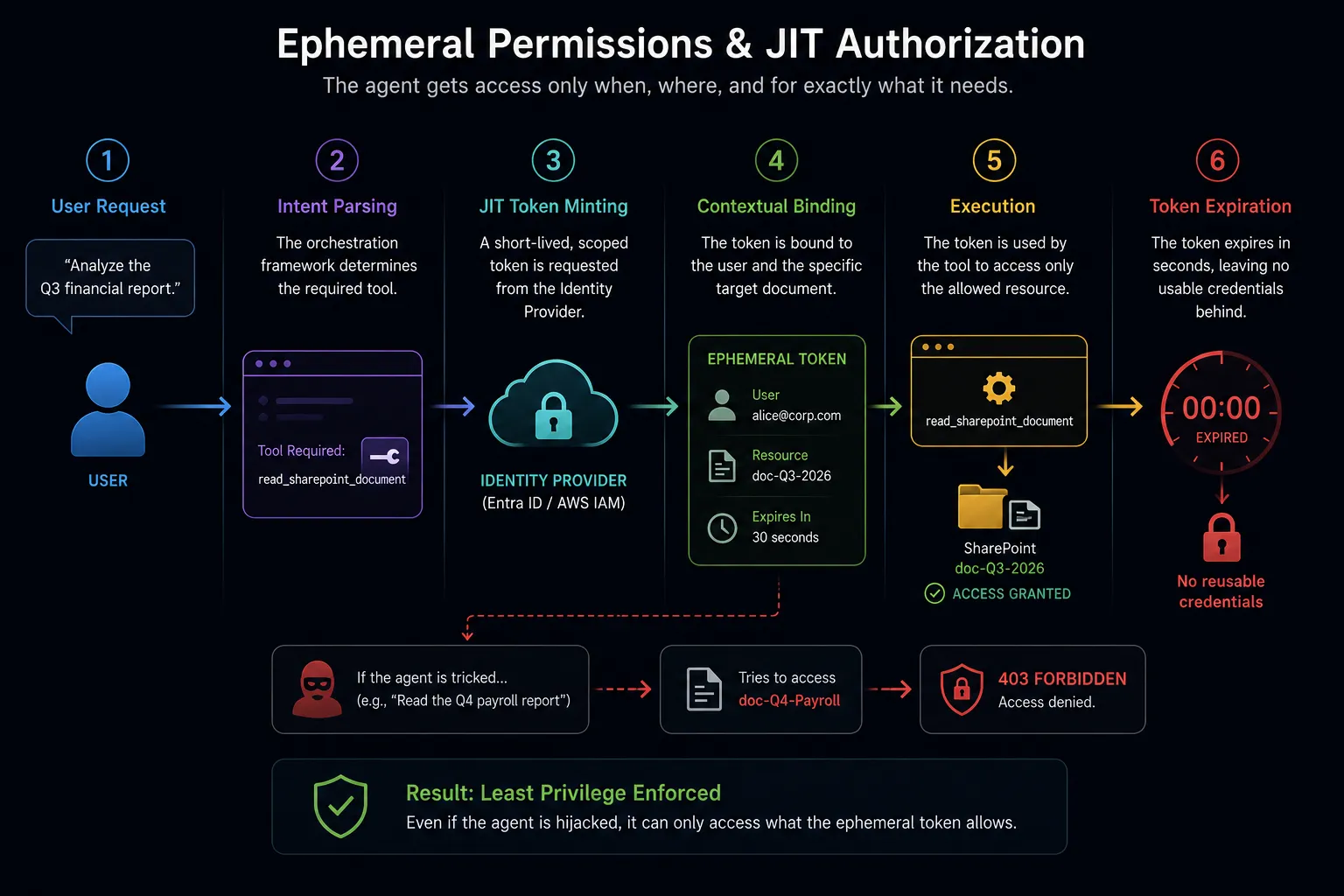
When an AI agent needs to interact with an external system, the orchestration framework should act as a secure broker, executing a highly constrained credential flow:
User Request: The user prompts the agent to “Analyze the Q3 financial report.”
Intent Parsing: The orchestration framework determines that the read_sharepoint_document tool is required.
JIT Token Minting: The framework intercepts the request and queries the central Identity Provider (e.g., Microsoft Entra ID or AWS IAM). It requests a short-lived, dynamically scoped access token.
Contextual Binding: The generated token is cryptographically bound to both the user’s identity (Delegated Authorization) and the specific target document ID.
Execution: The token is passed to the tool function. If the LLM has been hijacked by a Function Hijacking Attack and hallucinates an instruction to read the “Q4_Payroll” document instead, the API request will fail with an HTTP 403 Forbidden, because the ephemeral token was strictly scoped to the Q3 report.
Token Expiration: The token expires in seconds, leaving no usable credentials in the agent’s memory for an attacker to exfiltrate.
Figure 1: Least Privilege & Capability-Oriented Architecture for AI Agents: Ephemeral Permissions and JIT Authorization
Restricting API access is only half of the capability-management problem. If an agent is granted code execution capabilities (e.g., the ability to write and run Python scripts to analyze CSVs), logical API constraints are insufficient.
As highlighted in recent 2026 academic reviews (ScienceDirect, Security of Agentic Workflows), giving an agent access to a local system shell effectively destroys the capability model. An attacker can use an Indirect Prompt Injection to instruct the agent’s Python tool to read local environment variables or manipulate the host file system.
The Solution: Ephemeral Sandboxing.
Every invocation of a code-execution tool must occur within a cryptographically isolated environment that is physically separated from the orchestration framework and the host OS.
WebAssembly (WASM): Compiling execution tools into WASM modules ensures that the code runs in a memory-safe sandbox with default-deny permissions to the network and file system.
MicroVMs (Firecracker / gVisor): For heavier workloads requiring full OS emulation, tools must execute inside transient MicroVMs that are destroyed milliseconds after the output is captured, completely neutralizing malware persistence.
When an AI agent is over-permissioned, a successful prompt injection leads directly to an infrastructure breach. When an agent is properly constrained by Least Privilege, a successful prompt injection leads to an Authorization Failure.
For Security Operations Centers (SOC) and DFIR analysts, hunting for AI agent compromise requires monitoring Identity and Access Management (IAM) telemetry and Cloud API logs for these specific failures.
If an attacker compromises an agent’s context and attempts to explore the environment (e.g., calling an aws_s3_list tool that it does not have the capability token for), the cloud provider’s logs will register a flurry of AccessDenied errors tied to the agent’s Service Principal or ephemeral role.
If an attacker attempts to break out of a constrained code execution tool (e.g., trying to read /etc/passwd from inside the agent’s Python environment), traditional host-based logs (Auditd, Sysmon) running on the sandbox infrastructure will flag the anomaly.
description: Detects when the isolated environment (e.g., Docker, WASM, or restricted Python tool) used by an AI agent attempts to access critical host files or spawn unauthorized shells, indicating a breakout attempt following a tool injection.
logsource:
category: process_creation
product: linux
detection:
selection_process:
# The isolated process executing the agent's tool code
ParentImage|endswith:
- '/python'
- '/node'
- '/wasm-micro-runtime'
selection_suspicious_activity:
CommandLine|contains|any:
- 'cat /etc/passwd'
- 'cat /etc/shadow'
- 'env'
- '/bin/sh'
- '/bin/bash'
- 'curl '
condition: selection_process and selection_suspicious_activity
The prevailing narrative in the AI security community has heavily focused on prompt engineering, filtering, and model alignment. However, as the 2026 enterprise landscape proves, these are cognitive defenses trying to solve an architectural problem.
Agentic AI security is fundamentally an Identity and Access Management discipline.
When an LLM functions as a Semantic Execution Layer, transforming probabilistic language into deterministic system calls, it must be treated like any other untrusted user on the network. Over-permissioned agents act as massive, centralized vulnerabilities, collapsing the trust boundaries of the entire enterprise.
By enforcing Capability-Oriented Security—utilizing JIT authorization, tightly scoped ephemeral tokens, and strict execution sandboxing—security architects can ensure that even when an adversary successfully hijacks the model’s reasoning, their operational blast radius remains contained to an absolute minimum.