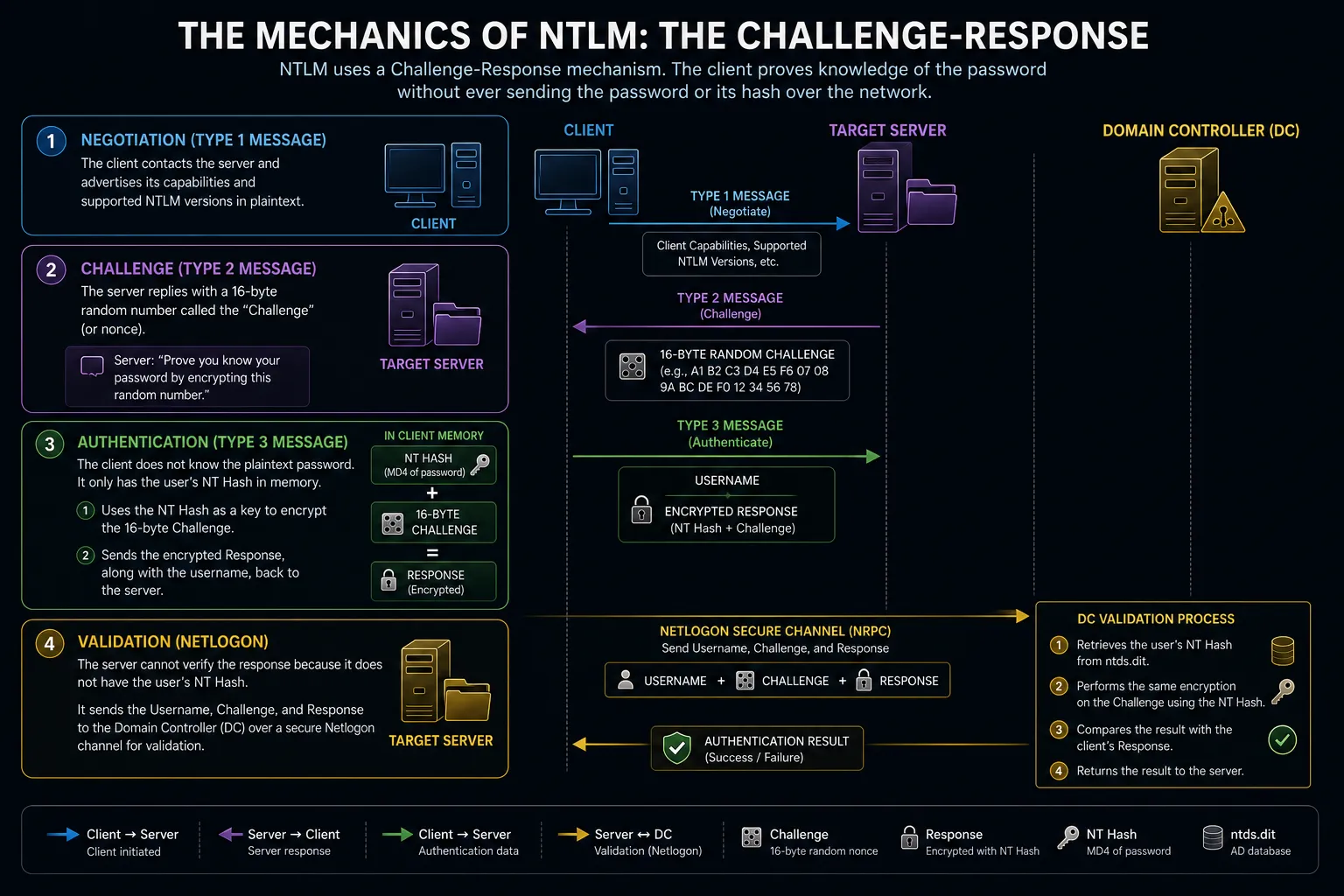
Unlike modern protocols, NTLM does not rely on ticketing systems or third-party identity providers during the initial exchange. It utilizes a Challenge-Response mechanism.
When a client (e.g., a workstation) attempts to access a resource on a target server (e.g., an SMB file share), the following sequence occurs:
Negotiation (Type 1 Message): The client contacts the server and advertises its capabilities and supported NTLM versions in plaintext.
Challenge (Type 2 Message): The server replies with a 16-byte random number known as the “Challenge” (or nonce). The server essentially says: “Prove you know your password by encrypting this random number.”
Authentication (Type 3 Message): This is the critical step.
The client does not know the plaintext password. It only holds the user’s NT Hash (an MD4 hash of the password) in memory.
The client uses the user’s NT Hash as a cryptographic key to encrypt the server’s 16-byte Challenge.
The resulting encrypted string is the Response. The client sends this Response, along with the username, back to the server.
Validation (Netlogon): The target server receives the Response but cannot verify it because it does not possess the user’s NT Hash.
The server establishes a secure Netlogon channel to the Domain Controller (DC) and passes the Username, the original Challenge, and the client’s Response.
The DC retrieves the user’s NT Hash from its database (ntds.dit), performs the exact same mathematical encryption on the Challenge, and compares its result with the client’s Response.
If they match, the DC tells the server the authentication is valid.
NTLMv2 was introduced to patch catastrophic cryptographic weaknesses in NTLMv1.
Feature
NTLMv1 (Critically Weak)
NTLMv2 (Modern Standard)
Challenge Handling
Uses only the Server Challenge.
Combines the Server Challenge with a Client-generated Challenge.
Replay Attack Resistance
Highly vulnerable.
Incorporates a Timestamp into the response, making replay attacks significantly harder.
Cryptographic Strength
Uses weak DES encryption, easily cracked by Rainbow Tables (e.g., L0phtCrack).
Uses HMAC-MD5, providing much stronger cryptographic integrity.
The Fundamental Flaw: While NTLMv2’s client challenge and timestamp successfully mitigate simple replay attacks, it does not fix the protocol’s core architectural sin: it still relies on the user’s NT Hash as the ultimate cryptographic secret.
Because of its architecture, NTLM exposes networks to two devastating attack vectors.
Pass-the-Hash (PtH)
If an attacker compromises a machine and dumps the LSASS memory, they extract the user’s NT Hash. Because NTLM only requires the NT Hash to encrypt the challenge (Step 3), the attacker never needs to crack the plaintext password. They simply pass the stolen hash into their own authentication request to move laterally.
NTLM Relaying
Unlike Kerberos, NTLM lacks Mutual Authentication. The client authenticates to the server, but the server does not prove its identity to the client. An attacker can position themselves as a Man-in-the-Middle (MitM). When a victim attempts to authenticate, the attacker intercepts the Type 1 message, relays it to a target server, receives the Type 2 Challenge, sends it back to the victim, and relays the victim’s valid Type 3 Response to compromise the target server.
If Kerberos is superior, why does NTLM traffic still exist on corporate networks? The protocol serves as an automatic fallback mechanism:
IP Address Access: Kerberos requires Service Principal Names (SPNs), which rely on Fully Qualified Domain Names (FQDNs). If a user or application accesses a server via its IP address (e.g., \\192.168.1.50\C$), the system automatically downgrades to NTLM.
Workgroups: In peer-to-peer networks without an Active Directory Domain Controller, NTLM is the only available protocol.
From a Blue Team perspective, tracking NTLM usage is a dual-purpose activity: discovering legacy technical debt and hunting for active lateral movement.
Domain Controllers log Event ID 4776 (“The computer attempted to validate the credentials for an account”) for every NTLM Netlogon validation request. A sudden spike in 4776 failure events is a massive red flag for a Password Spraying or Brute Force campaign.
Understanding NTLM’s flaws is the first step in Active Directory security. To understand how modern networks secure authentication and prevent NTLM Relaying, we must dive into its successor.